The New World Order Is Not the Part You Should Fear
- Wayne Bodie
- Apr 18
- 6 min read

What unsettles people is rarely the arrival of a new system. It is the violent and disorienting death of the old one.

People hear phrases like Agenda 2030, global reset, or New World Order and immediately split into camps. Some dismiss it all as paranoid theater. Others treat it as the final script for human enslavement.
Both reactions miss the deeper point.
The first mistake is pretending that global coordination is some fringe fantasy. It is not. The language has been public for years. International institutions, transnational forums, banking systems, and political leaders have spent decades speaking openly about restructuring, cross-border alignment, and the need to rethink how the world will be governed, financed, and stabilized in the years ahead.
The public was told for years. It just was not told plainly.
The second mistake is assuming the thing to fear most is the new order itself.
It is not.
The thing people will fear most is the transition.
History shows this again and again. Systems do not disappear politely. They decay, wobble, overcorrect, centralize, and then begin shedding their old skin in ways that feel chaotic from the inside. What later gets called a new era rarely feels new at first. It feels like confusion. It feels like loss. It feels like a breakdown in the meanings people once trusted.
That is where we are headed, or at the very least where the major institutions of the world appear to believe we are headed.
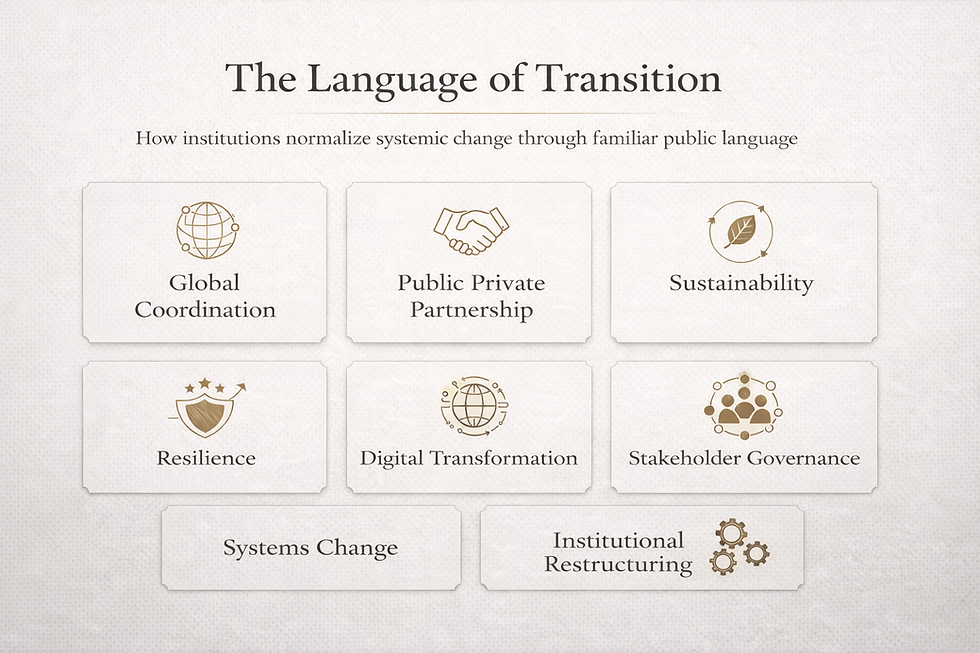
For years, the public has been trained to think in slogans. Sustainability. Resilience. Stakeholder capitalism. Public private partnership. Systems change. Digital transformation. Behind all of them sits the same deeper instinct: the old arrangement is no longer viewed as stable enough to carry the future. Whether one sees that as wise planning or elite overreach, the direction of travel is not hard to recognize.
That is why so many people are preparing themselves for the wrong fear.
They fear the label, but not the mechanism.
They fear the phrase, but not the process.
They fear the architecture, but not the demolition required to build it.
People fear the label, but the process is what hurts.
The demolition is the hard part.
A civilization built on paper claims, inflated abstractions, debt dependency, institutional trust, and inherited assumptions does not glide gently into a new operating system. It convulses. It resists. It clings. Entire generations have been trained to measure value through physical accumulation, legacy assets, real estate, conventional employment ladders, and currencies backed more by confidence than substance.
If those assumptions are being rewritten, then the greatest shock will not be technological. It will be psychological.
That is what people mean when they sense a shaking coming, even if they do not yet have language for it.
Something old is dying.
And when something old dies, there is always a period where the world looks less like order than labor, less like progress than pain, less like construction than collapse.
A new system is never born without the death of an old one.
This is where many of the loudest commentaries go wrong. They frame the future as if it were only a scheme designed in secret rooms by cold men with polished shoes and global access badges. There is some truth in that image. Power does coordinate. Financial networks do shape outcomes. Institutions do not accidentally move in parallel forever.
But that is still too shallow an explanation for what is happening.
The deeper explanation is that history has a rhythm. Empires rise on one set of values and fall when those values become too heavy to sustain themselves. Financial orders harden until they become brittle. Political systems expand until they can no longer hide their contradictions. What people experience as a sudden crisis is often the visible phase of a transition that has been forming quietly for decades.
The hardest transition is not political. It is psychological.
When a system shift begins, it does not only affect policy. It reaches into the ordinary structure of life. Money becomes unstable. Work becomes uncertain. Identity becomes strained. Trust erodes. Property changes meaning. Institutions wobble. Social norms stop feeling permanent. What appears on the surface to be a political or economic transition is often experienced by ordinary people as personal dislocation.

That is why the panic runs so deep. It is not merely that people fear new leaders, new rules, or new technologies. They fear losing the familiar grammar of life. They fear waking up inside a world where the old signals no longer work, where the things that once felt stable no longer do, where the old storehouses of value no longer hold what people assumed they held.
The real fracture begins when old definitions of value stop holding.
We have seen versions of this before. Not the same technology, not the same institutions, not the same vocabulary, but the same structural rhythm: concentration, instability, legitimacy loss, reorganization, redefinition of value, emergence of a new governing logic.
That is why so much of what is happening now feels strangely familiar, even when it appears unprecedented.
History does not move randomly. It moves in cycles, convergences, repetitions, and mirrors. What seems chaotic from the inside often looks patterned from a longer distance. What feels like breakdown in the moment is often the middle stage of a larger realignment.
What feels like chaos in the middle often becomes pattern in hindsight.
Call it globalization. Call it a managed transition. Call it a reset. Call it Agenda 2030. Call it what earlier generations called a New World Order.
The name matters less than the pattern.

And if the pattern holds, the most painful stretch will not be the unveiling of a new system. It will be the in-between period where the old one is too weak to function as it once did, but the new one is still too incomplete to provide emotional or economic certainty.
That is the zone where people panic, rage, hoard, scapegoat, and mistake labor pains for the end of reality itself.
But birth and collapse often look alike in the middle.
That is the part almost nobody wants to hear.
The future may not arrive as a clean handoff from one world to another. It may arrive as a rough, prolonged, and deeply disorienting transition in which old storehouses of value no longer feel safe, old definitions of identity no longer hold, and old methods of exchange begin losing their authority.
The crisis will not simply be institutional. It will be personal. Men and women will feel it in their wallets, their work, their communities, and their sense of what the world is even for.
So no, I do not think the real question is whether some version of a new global order is coming.
I think the more honest question is whether ordinary people understand what such transitions actually cost.
Not just politically.
Not just economically.
Psychologically. Socially. Even spiritually, whether one likes that word or not.
Because what breaks in a transition is not merely policy. It is attachment.
Attachment to the familiar.
Attachment to the measurable.
Attachment to the old story of value, power, work, permanence, and control.
That is why the fear is so intense. People think they are afraid of tyranny. Some are. People think they are afraid of surveillance. Some are. People think they are afraid of elite coordination. Fair enough.
But deeper down, many are afraid because they can feel that the world that formed them is passing away.
And they are not wrong.
So take a breath.
The phrase New World Order has been used for so long, by so many people, in so many tones, that it now triggers fear before thought. But fear is not analysis. Panic is not pattern recognition. The more useful response is not hysteria, but sobriety.
Watch the language.
Watch the institutions.
Watch the money.
Watch the patterns.
Above all, watch what happens when a civilization realizes that its old way of assigning value no longer works.
That is when history stops feeling theoretical.
That is when the birth pains begin.
Readers interested in the deeper historical framework behind this essay can explore it further in my book, The Seventy Sevens.More essays and books can be found at Wayne Bodie Books.Related video work is available on YouTube.
Hey my friend! I gave you a little rating on your article! I haven't read it fully yet, but I will when I get the chance, and drop a little comment here. Peace my friend!
WOW!!! Amazing, insightful, powerful article. Best explanation, bar none, I’ve read of the NEW WORLD ORDER!!